Portland Metro Market Update — January 2026: The Effort Market
I had coffee last week with a couple who's been watching the market since last summer. They've saved aggressively, got pre-approved, and have been casually touring homes on weekends. When I asked what was holding them back, the husband said something I've been hearing a lot lately: "We just don't know what's going to happen."
Fair enough. Nobody does. But here's what I do know — and what the January numbers actually tell us.
What January Looks Like
January is always the slowest month in Portland real estate. It's the deep breath before the year starts moving. Sellers are meeting with agents, getting bids on that kitchen remodel they've been putting off, prepping to hit the market when the weather breaks. Buyers are running the math, watching rates, trying to read the tea leaves.
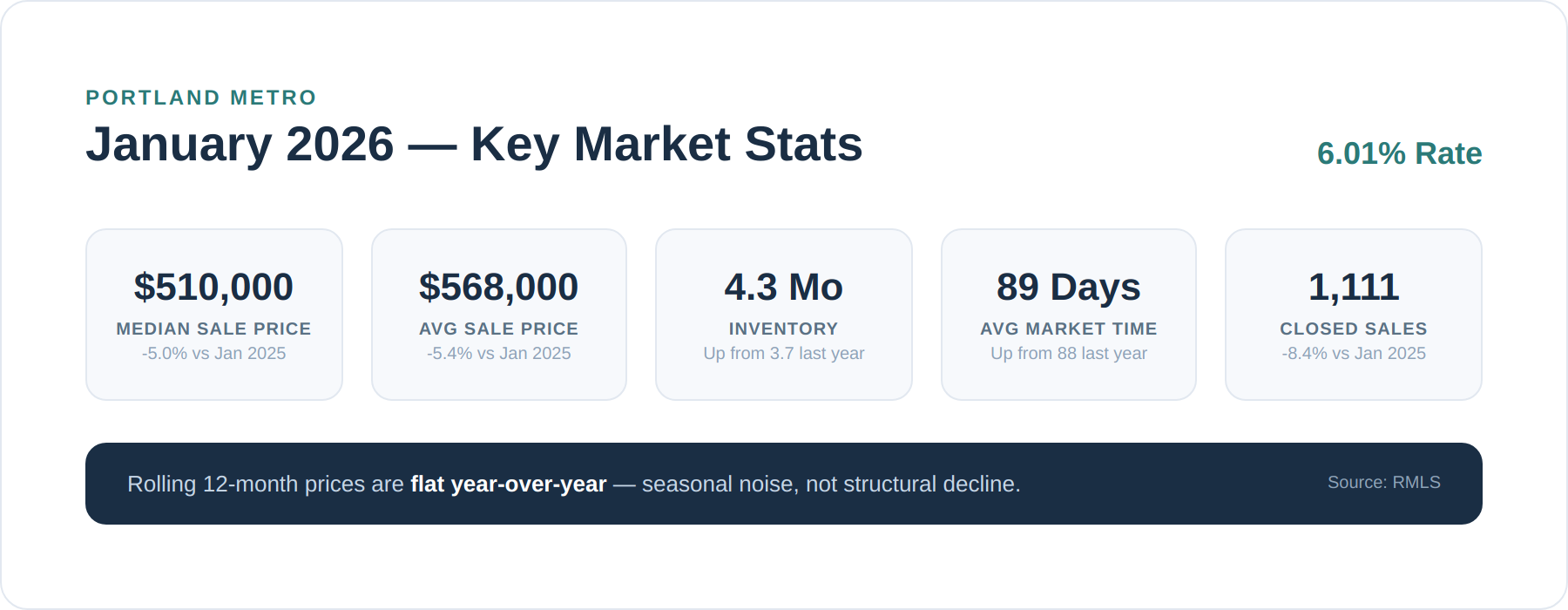
This January was quieter than last. Closed sales across the Portland metro came in at 1,111 — down about 8% from January 2025. New listings dropped roughly 4%. Pending sales were essentially flat year-over-year.
None of that is alarming. It's a slow January doing what slow Januarys do.
But inventory continues to build. We're sitting at 4.3 months of supply, up from 3.7 a year ago and 3.2 in January 2024. That's a meaningful trend. Homes are sitting longer too — 89 days average market time. Not dramatic, but directionally important.
The takeaway: buyers have more options and more time than they've had in years. Sellers need to earn the sale.
The Price Picture
Here's the number that should get your attention. Comparing January 2026 to January 2025, the average sale price dropped 5.4% — from $600,300 to $568,000. The median fell 5% — from $537,000 to $510,000.
Now, before anyone panics, zoom out. The rolling 12-month average and median sale prices are both flat year-over-year — unchanged at $610,400 and $545,000 respectively. What you're seeing in the January-to-January comparison is seasonal noise amplified by a softer winter market, not a structural decline.
Prices are flat. Not crashing. Not surging. Flat.
And flat, in an environment where mortgage rates have dropped to their lowest level in over three years, is actually a pretty interesting setup.
The Rate Story (And Why It Matters More Than You Think)
The 30-year fixed mortgage rate just hit 6.01% — the lowest weekly average since September 2022. A year ago, that number was 6.85%. That's a meaningful reduction in monthly payment for anyone buying right now.
Here's some quick math. On a $500,000 home with 20% down, the difference between a 6.85% rate and a 6.01% rate saves you roughly $220 per month. That's $2,640 a year. Over 30 years, it's nearly $80,000 in interest you're not paying.
That's not a rounding error. That's a second car. That's a year of college tuition. That's money compounding in your favor instead of the bank's.
Refinance activity has more than doubled over the past year. Existing homeowners are paying attention. Buyers should be too.
The Tension: Rates vs. Uncertainty
So rates are down, prices are flat, and there's more inventory than we've seen in years. Sounds like a buyer's market, right?
Not quite. Because there's a countervailing force — uncertainty. Geopolitical instability, economic policy questions, and a general sense that the world is a little unpredictable right now are keeping some buyers on the sidelines. The couple I mentioned at the top? That's exactly where they are.
I get it. Uncertainty is uncomfortable. But here's the thing about uncertainty — it never fully resolves. There's always something. If you wait for perfect clarity, you'll wait forever, and you'll pay more for the privilege.
The Fed held rates steady at its last meeting after cutting three times in late 2025. If the economy softens and downward pressure on rates continues — which several forecasters expect — we could be looking at a genuinely strong spring market. More buyers coming off the sidelines. More competition. Higher prices.
The window where you get low rates and flat prices and high inventory doesn't stay open indefinitely.
What I'm Seeing in Our Neighborhoods
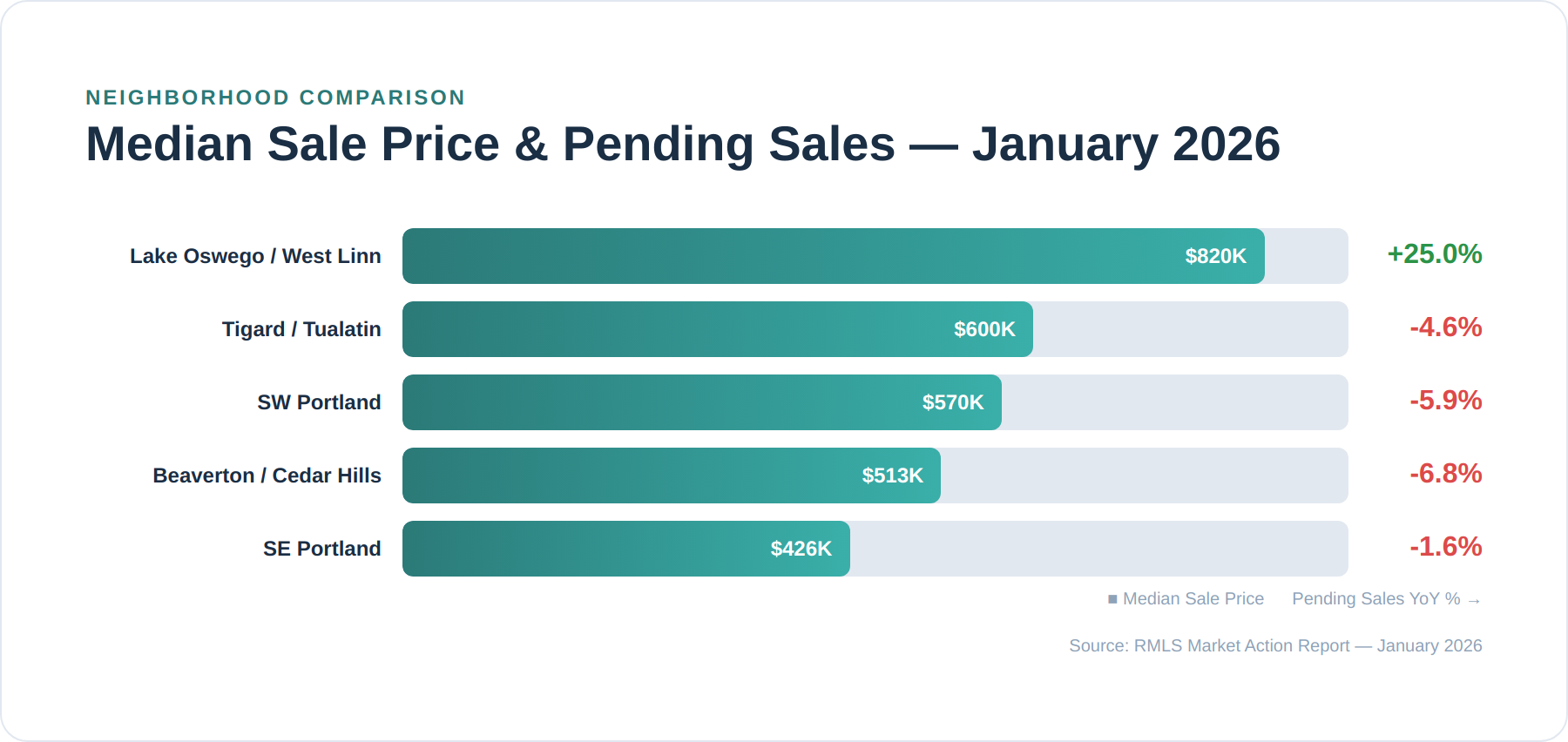
Lake Oswego / West Linn is the standout this month. Pending sales jumped 25% year-over-year — easily the strongest performance in the metro. The median hit $820,000 with an average sale price of $1,147,200. Buyers at the higher end of this market are active and motivated. If you own in this corridor and have been thinking about selling, the demand signal is clear.
SW Portland saw some softening — pending sales down about 6%, with the average sale price at $616,200 and median at $570,000. Inventory is higher here at 697 active listings, the most of any area in the metro. That means presentation and pricing matter more than ever on the west side. The good homes are still moving. The ones that aren't prepared are sitting.
SE Portland is holding relatively steady. Pending sales dipped just 1.6%, and the median sale price is $425,500. This remains one of the most active areas in the metro with 124 closed sales in January alone. For buyers looking for value close-in, SE continues to deliver.
Beaverton / Cedar Hills saw pending sales pull back about 7%, with a median of $512,500. But the rolling 12-month average price is actually up 1.4% — a sign that the underlying trend is still positive even if January was a slower month.
Tigard / Tualatin / Wilsonville was down about 5% in pending sales with a $600,000 median. This area had 114 closed sales — healthy activity for January — but the 91-day average market time tells you buyers are being deliberate. Homes that are priced right and show well are still getting absorbed. Everything else waits.
What Sellers Should Be Doing Right Now
If you're thinking about selling this spring or summer, January and February are your planning months. This is when the work gets done — not the glamorous work, but the work that makes your home sell faster and for more money.
Get the inspection items handled. Paint over that dated accent wall. Fix the fence. Stage the living room. Price it right from day one.
Because here's the reality of this market: well-prepared homes still sell. The overall 89-day average market time is telling you that the market is separating the prepared from the passive. Buyers have choices now, and they're being selective. The days of throwing a sign in the yard and collecting multiple offers within a weekend are behind us for most properties.
That's not a bad thing. It just means effort matters again.

The Bottom Line
This is an effort market. It rewards preparation, patience, and clear thinking over speculation and emotion.
For buyers: rates are the lowest they've been in three years. Inventory is growing. Prices are flat. You have leverage you haven't had since before the pandemic — but that leverage has a shelf life.
For sellers: the spring window is approaching fast. The work you do in these quiet February and March weeks is what separates a 30-day sale from a 90-day slog.
And for everyone sitting on the sidelines — real estate has always been a long game. The people who build wealth through homeownership aren't the ones who time the market perfectly. They're the ones who buy when the math works, hold through the cycles, and let time and leverage do the heavy lifting.
The math works right now. If you want to run the numbers together, I'm happy to walk you through it.
Data source: RMLS Market Action Report, Portland Metro — January 2026 Reporting Period.