Headlines vs. Reality: What March 2026 Is Actually Telling Us
Rates bounced around on dramatic geopolitical headlines. Buyers hesitated on the national level. Portland's spring market showed up anyway.
I've been having the same conversation on repeat for the last three weeks. It goes something like this:
"With everything going on — the conflict overseas, the tariff stuff, rates bouncing around — is this even a good time to be thinking about moving?"
I get it. When the world feels unstable, the instinct to sit on your hands is strong. It's also, historically, one of the more expensive instincts we have. So let me tell you what actually happened in the Portland metro in March — because the numbers and the national mood are telling very different stories.
The short version
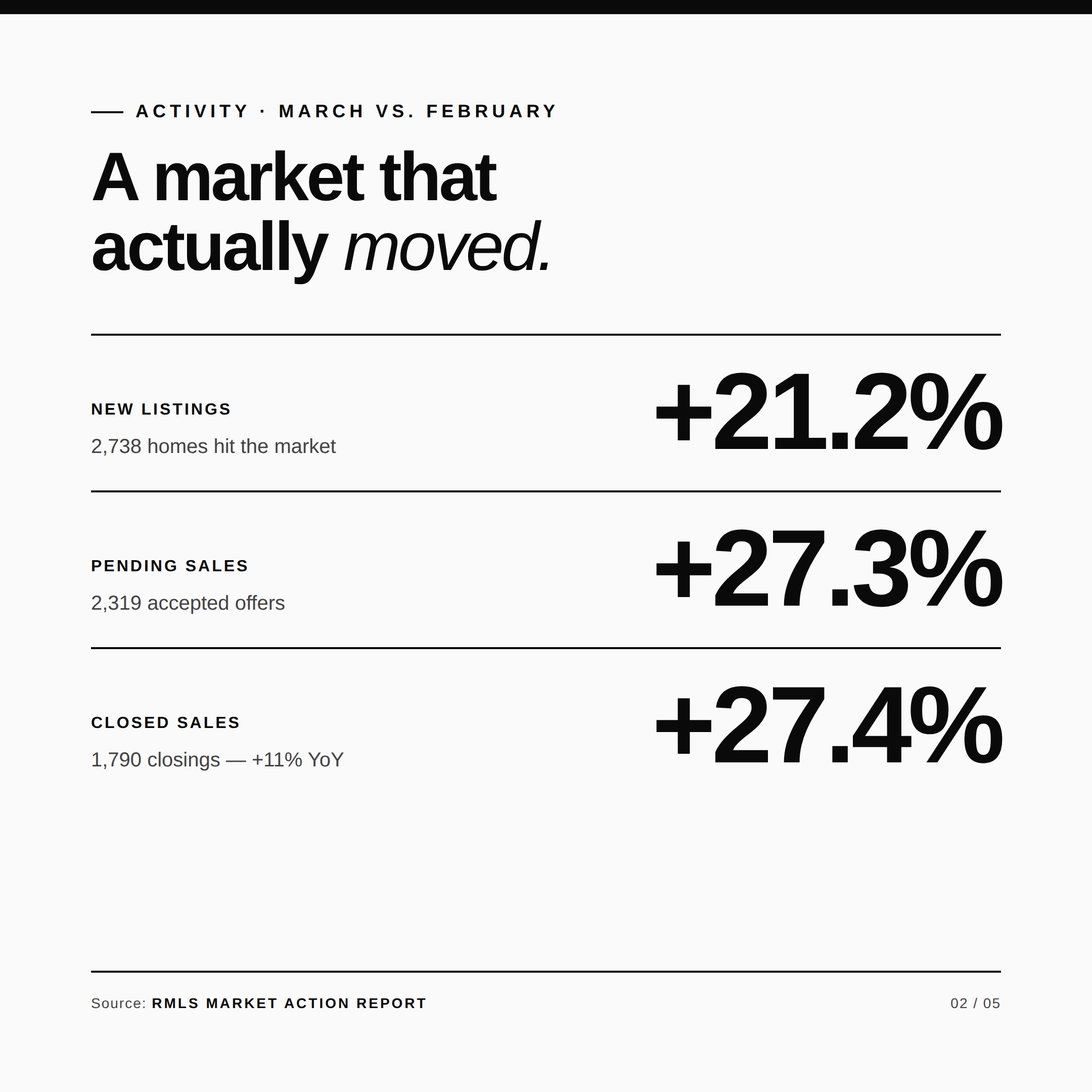
March 2026 was the strongest month of the year so far, by a wide margin. Compared to February:
New listings were up 21.2% — 2,738 homes hit the market
Pending sales were up 27.3% — 2,319 accepted offers
Closed sales were up 27.4% — 1,790 closings, also up 11% year-over-year
That is not a market freezing up in response to a scary news cycle. That is buyers and sellers stepping back in after the winter hibernation and doing what they do every spring — moving. The seasonal rhythm of real estate is stubbornly persistent, even when the news is not.
But the headlines are real. So is their effect on rates.
I'm not pretending the macro noise doesn't matter. It does — mostly through the mortgage rate pipeline.
Here's the quick version of what rates did. We entered 2026 with rates falling and a lot of optimism. By late February, qualified borrowers were sniffing around 5%. Then geopolitical tensions escalated sharply in early March, oil prices jumped, inflation expectations recalibrated, and rates spiked — touching roughly 6.7% in late March before settling closer to 6.25% this past week.
That's a real swing in about six weeks. On a $700,000 loan, that's a couple hundred dollars a month in payment difference. Real money.
And that is what caused the national buyer pullback you're reading about. It wasn't a pullback in desire. It was a pullback in monthly payment math.
One thing to keep on your radar: there's going to be a shakeup at the Fed in mid-May, and a lot of folks are reading that as a clear signal that rates are coming down. My honest read? It'll probably put some slight downward pressure on rates in the short term — but until the geopolitical situation actually settles, I wouldn't expect any dramatic move in either direction. Rates are being pulled by forces well outside the Fed's control right now.
The two markets
Here's what I'd call the most important idea in this whole report: we are not in one market. We're in several at once, and they're behaving differently.
In the neighborhoods I work in, every single submarket is up on year-to-date pending sales. But the pace varies dramatically:
Beaverton / Aloha: pending sales +16.2% year-over-year in March. Median $541,000 YTD. This is the steadiest, most consistent corner of the metro right now — priced for median-income buyers who are actually transacting.
Lake Oswego / West Linn: YTD pending sales +14.9%. The high end is alive and well on a quarterly basis, even though March itself took a small breather (pending -14.6% for the month). At $820,000 YTD median and average sale prices pushing past $1M, this is a market where individual transactions matter more than the monthly average.
SW Portland: YTD pending +4.4%, with a YTD median around $653,500. Highest active inventory count on this side of town (821 active listings) — choice is abundant here.
Tigard / Tualatin / Wilsonville: pending +2.7% in March, YTD median $610,000. Healthy, if slightly slower.
SE Portland: pending +1.4% in March, YTD median $443,000. The entry-point price tier on this list and the slowest of the five — but still positive.
Translation: there is no single "Portland market" doing one thing. Anyone telling you "the market is hot" or "the market is dead" is either selling you something or not paying attention. Beaverton in March 2026 is not Lake Oswego in March 2026, and neither is SE Portland.
What sellers need to understand this month
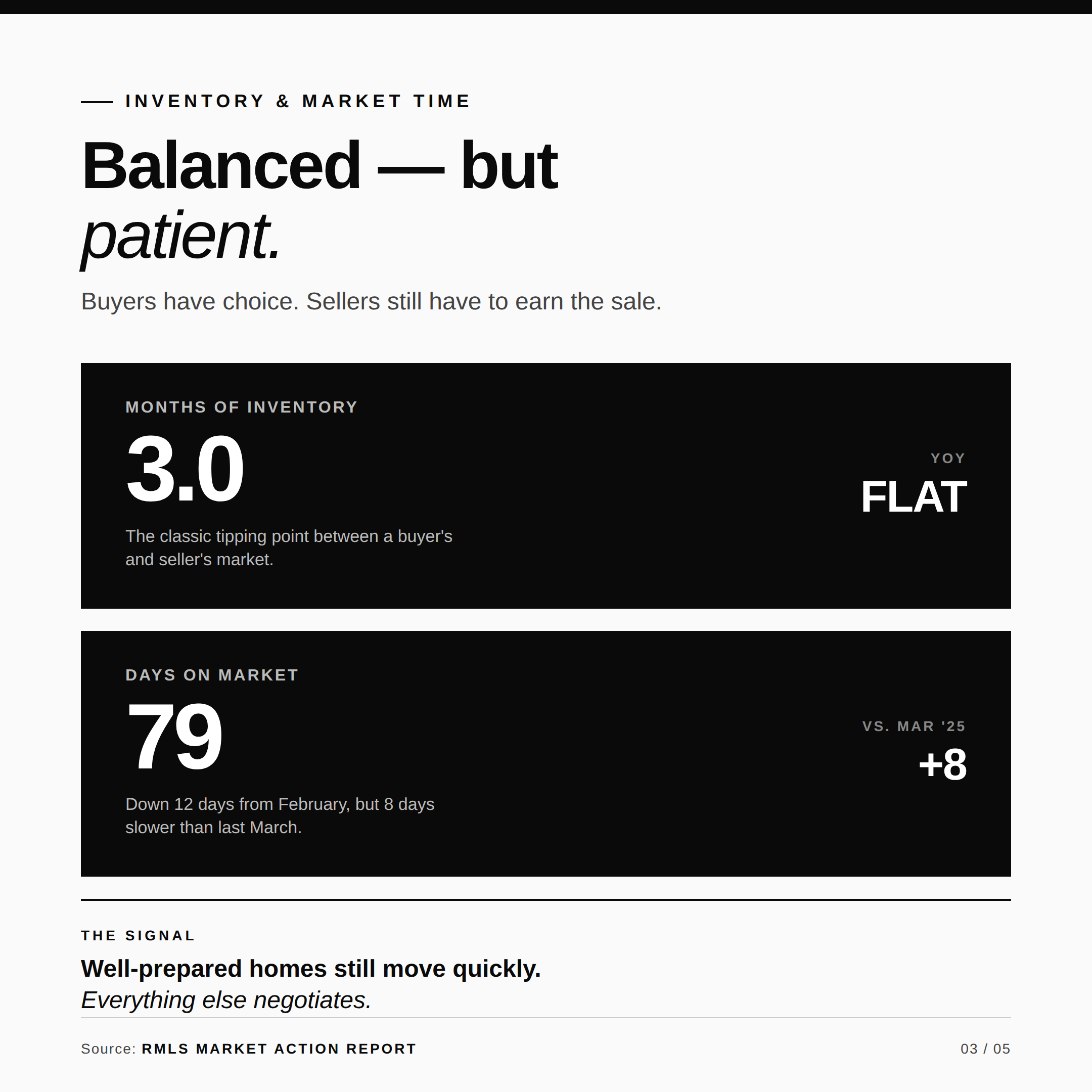
Inventory sits at 3.0 months across the metro. That's the textbook tipping point between a buyer's market and a seller's market — dead center. Total market time is 79 days. That's a full week longer than last March.
So yes, homes are still selling. But the sale is being earned now, not handed to you by momentum.
What I'm telling my seller clients, plainly:
Fix the deferred maintenance. The broken disposal, the chipped baseboards, the fence that's leaning. Buyers right now have choice, and choice makes them picky.
Price it to the comps, not to the dream. The average list-to-sale spread in Portland was -0.5% in March. Homes are generally selling slightly under list. Price accordingly and you'll get traffic; price aspirationally and you'll sit.
Presentation is not optional. Staging, photography, and the first 48 hours on the market matter more than ever. This is where Courtney's latest piece on staging-for-a-slower-spring over on the blog is genuinely worth your time.
The sellers who prep their homes are still winning. The ones who assume the market will bail them out are learning an expensive lesson.
What buyers need to understand this month
You have more leverage than you had during the frenzy years. You do not have unlimited leverage.
The best buying opportunities right now are not "negotiate 10% off any listing." They are homes with solvable problems — weird paint, a listing agent who didn't stage well, a price that was too ambitious on week one and is now sitting at day 60. Those are the deals. A well-priced, turnkey home in Lake Oswego or Beaverton is still getting competitive offers. I've seen multiple-offer situations this month.
A few things I'd say to buyers specifically:
The rate environment is volatile. That's two-way volatility. Rates spiked to 6.7% and pulled back to 6.25% in three weeks. Waiting for "certainty" is a losing strategy — you're essentially trying to time a market moved by oil prices and geopolitics. Nobody times that well.
Buy the house, date the rate. You're locking in the price of the asset today. The financing is refinanceable. The house, once sold to someone else, is not.
Look at stale inventory. Anything past 45 days on market is worth a second look. The seller's expectations have adjusted, even if the list price hasn't fully caught up yet.
The bigger picture — why I'm calm
Real estate is the slowest-moving asset class most people will ever own. That's a feature, not a bug. Stocks can lose 20% in a week on a headline. Housing simply doesn't move that fast — and the Portland metro median has been essentially flat for two years now, bouncing between roughly $525,000 and $545,000.
That's a healthy market doing what healthy markets do: absorbing shocks slowly, finding equilibrium, not overreacting. In a world where everything else seems to be reacting to everything all the time, that stability is a feature worth paying for.
The people who build real estate wealth don't do it by timing the perfect moment. They do it by buying reasonable assets, holding them through multiple cycles, letting inflation and amortization do the compounding, and not getting shaken out by the noise. Every headline-driven pullback in my career has looked, five years later, like an opportunity that most people talked themselves out of taking.
Where to from here
My honest read on the next 60-90 days: inventory will keep climbing into early summer (that's seasonal), rates will stay choppy in the 6.0–6.5% range with maybe a slight downward bias after the Fed shakeup, and well-priced homes in the Lake Oswego / West Linn / SW Portland / Beaverton corridor will continue to transact at a healthy pace. Poorly prepped homes will sit. The price sensitivity at every price point above $800K has increased meaningfully — that's where I'd focus the most attention if you're a seller at the higher end.
If you're a buyer who's been on the sidelines, this is a market that rewards patience and preparation — not paralysis. Have your financing in order, know your neighborhoods, and be ready to move on the right property when you see it.
If you're thinking about moving — reply to this email or shoot me a text. No pressure, no pitch. Happy to walk you through the math on your specific situation and help you figure out whether now makes sense. Lake Oswego, West Linn, SW Portland, Beaverton, Tigard, Tualatin, or SE Portland — that's where I live and work, and I'm always up for a real conversation about it.
— Mark
Mark Reeves · Reeves Realty PDX · Data source: RMLS Market Action Report, March 2026 reporting period.